The Ethics of AI/ML in Identity Verification
Introduction
AI and machine learning (ML) are revolutionizing identity verification, enabling real-time fraud detection, liveness checks, and seamless onboarding. However, this transformation has brought a surge of ethical scrutiny from governments, regulators, watchdog groups, and the public. Key concerns include algorithmic bias, privacy, transparency, accountability, and the societal impact of automated identity decisions. This blog surveys the current landscape—drawing on literature, news, regulations, and industry responses—and provides recommendations for vendors, enterprises, and users.
1. Key Ethical Challenges in AI/ML-Based Identity Verification
Algorithmic Bias and Fairness
Perhaps the most urgent ethical challenge is algorithmic bias. AI systems often inherit biases from their training data, leading to discriminatory outcomes—especially in facial recognition and biometric verification. NIST studies have shown that facial recognition algorithms can have false [1] [2] match rates up to 100 times higher for women and people with darker skin tones. This can result in exclusion, wrongful denial of service, or even legal consequences for affected individuals.
Industry Response:
Vendors like Transmit Security and Mitek emphasize the need for diverse, representative training datasets, regular algorithmic audits, and transparent reporting on system performance [2] [3] across demographic groups. Apple, for example, touts its commitment to fairness and [4] privacy by ensuring on-device processing and minimizing data sent to the cloud.
Privacy and Data Protection
AI-driven verification systems require vast amounts of sensitive personal data, including biometrics and behavioral patterns. This raises questions about:
What data is collected and why?
How long is it retained?
Who has access and under what conditions?
How is user consent obtained and managed?
Regulations like GDPR (EU), CCPA (California), and others set strict requirements for data [1] [5] [6]minimization, consent, and user rights. Apple’s “privacy by design” approach, Google’s deletion of biometric data after use, and Microsoft’s robust access controls are examples of [4] [7] [8] industry efforts to address these concerns.
Transparency, Explainability, and Accountability
AI/ML models are often “black boxes,” making it difficult for users or regulators to understand how decisions are made. This lack of transparency can erode trust and make it hard to challenge unfair outcomes.
Best Practices:
[9] Use of “Model Cards” to document model development, evaluation, and intended use.
Regular, independent audits and public reporting of system performance. [1] [10] [8]
Human-in-the-loop oversight for sensitive or high-risk decisions.
Security and Adversarial Attacks
AI-based systems are targets for adversarial attacks, such as deepfakes or injection attacks, which can manipulate verification processes. Vendors must constantly update their models and [3] defenses to stay ahead of fraudsters.
Societal Impact and Accessibility
Automated identity verification can unintentionally exclude marginalized groups, the elderly, or those with disabilities. Ensuring accessibility and fairness is both an ethical and legal [11] imperative.
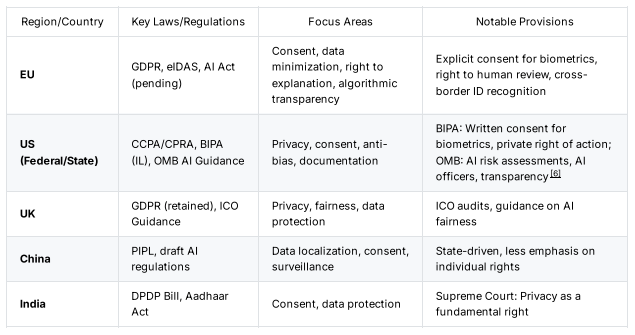
2. Regulatory Landscape: Laws, Mandates, and Recommendations
Global Regulatory Trends
Recent Developments
EU AI Act (2025): Will regulate high-risk AI, including identity verification, requiring transparency, risk assessments, and human oversight.
IRS/ID.me Oversight (US): GAO called for stronger documentation, transparency, and [10]
independent evaluation of AI-based identity proofing at the IRS.
Google’s Age Verification: Uses behavioral and facial AI, deletes biometric data after use, [7] and allows appeals for misclassification.
Microsoft’s AI Code of Conduct: Requires disclosure of AI-generated content, robust [8] security, and user consent .
3. What Are Vendors Doing? Industry Initiatives and Best Practices
Apple
4] Privacy by Design: On-device processing for AI/ML tasks; data rarely leaves the device.
Transparency: Code for server-side processing is available for independent inspection.
User Control: Users can manage, delete, and restrict access to their biometric data.
Behavioral and Facial AI for Age Verification: Combines behavioral signals with optional facial analysis; deletes biometric data immediately after use; allows manual verification for [7] disputes.
Ongoing Audits: Regularly refines models to reduce bias and error rates.
Microsoft
Responsible AI Code of Conduct: Requires technical and operational controls, [8] transparency, user consent, and human oversight for all AI-driven decisions.
Disclosure: AI-generated outputs must be clearly labeled.
AWS (Amazon Web Services)
Amazon Rekognition: Provides customizable, pre-trained AI for ID verification, with a focus [12]
on privacy, security, and compliance.
Customer Guidance: Recommends using Rekognition in compliance with local laws and best practices for privacy and fairness.
Specialized Vendors (ID.me, Veriff, Mitek, Transmit Security, etc.)
[13]Bias Mitigation: Use diverse training data, regular audits, and human-in-the-loop review
[2] [3] . Transparency: Publish whitepapers and participate in industry forums on AI ethics.
Certifications: Pursue SOC2, ISO, and FedRAMP certifications to demonstrate compliance [5] and security.
User Rights: Allow users to access, correct, or delete their data; provide redress for errors.
4. Key Points and Ongoing Challenges
1. Bias and Fairness
Challenge: Ensuring AI/ML models do not perpetuate or amplify discrimination. Response: Regular audits, diverse data, and transparent reporting.
2. Privacy and Consent
Challenge: Balancing operational needs with user privacy and regulatory requirements. Response: Data minimization, explicit consent, user control, and privacy-by-design.
3. Transparency and Explainability
Challenge: Black-box models undermine trust and accountability.
Response: Documentation, model cards, independent audits, and human oversight.
4. Security and Adversarial Robustness
Challenge: AI/ML systems are vulnerable to adversarial attacks (e.g., deepfakes). Response: Continuous model updates, multi-factor verification, and anomaly detection.
5. Societal Impact and Accessibility
Challenge: Preventing exclusion of marginalized groups and ensuring accessibility. Response: Inclusive design, regular testing across demographics, and user education.
6. Regulatory Compliance
Challenge: Navigating a complex, evolving web of global regulations.
Response: Ongoing legal review, certifications, and adaptive compliance frameworks. 5. Recommendations for Stakeholders
For Vendors
Invest in Diversity: Ensure training data represents all user groups.
Audit and Report: Regularly audit algorithms for bias and publish results.
Privacy by Design: Minimize data collection, maximize on-device processing, and secure user consent.
Transparency: Clearly explain how AI/ML models make decisions.
Certifications: Pursue recognized certifications (SOC2, ISO, FedRAMP) and participate in industry self-regulation.
For Enterprises
Vendor Due Diligence: Assess vendors for ethical practices, compliance, and transparency. User Education: Inform users about how their data is used and their rights. Incident Response: Prepare for errors or breaches with clear redress procedures.
For End Users
Know Your Rights: Understand local data protection laws and exercise your rights to access, correct, or delete data.
Demand Transparency: Choose services that clearly explain their AI/ML practices. Report Issues: Use available channels to report errors or unfair treatment.
6. The Road Ahead: Toward Ethical, Inclusive, and Trustworthy AI
Ethical AI/ML in identity verification is not just a technical challenge—it is a societal imperative. As regulations tighten and public scrutiny grows, only those vendors and enterprises that invest in fairness, transparency, privacy, and accountability will earn and retain user trust. The industry is moving toward a future where ethical considerations are not an afterthought but a core design principle.
Key Takeaway:
AI/ML-driven identity verification must be ethical by design—fair, transparent, privacy preserving, and accountable to all users.
References
[1] Avatier, "The Ethical Frontiers of AI in Identity Management"
[5] Snappt, "ID Verification Trends For 2025 & The Future Outlook"
[10] FedScoop, "Watchdog pushes IRS on stronger oversight of identity-proofing"
[14] Veriff, "AI compliance: Why it matters for financial services in 2025?"
[12] AWS, "Identity Verification | Machine Learning"
[4] Forbes, "Why Apple Intelligence Sets A New Gold Standard For AI Privacy"
[7] Adyog, "Google's AI Age Verification: Strengthening Child Safety Online"
[8] Microsoft, "Code of Conduct for Microsoft AI Services"
[6] CPO Magazine, "Proper ID Verification Requires Ethical Technology"
[13] ID.me Network, "Fighting the New Face of Identity Theft"
[2] Transmit Security, "Mitigating AI Bias in Identity Verification"
[3] Mitek, "How AI enables a new era of identity verification"
[11] OrgID, "Digital Identity: Unexpected Ways AI Changes Everything in 2025"
[9] LinkedIn, "Ethical Considerations in Machine Learning for Online Identity Fraud"
This blog is based on a survey of recent literature, regulations, and vendor publications as of June 2025. For the latest updates, consult regulatory authorities and vendor transparency reports.
Sources:
1. https://www.avatier.com/blog/the-ethical-frontiers-ai-in-im/
2. https://transmitsecurity.com/blog/mitigating-ai-bias-in-identity-verification
3. https://www.miteksystems.com/blog/how-ai-enables-a-new-era-of-identity-verification
4. https://www.forbes.com/sites/bernardmarr/2024/09/11/why-apple-intelligence-sets-a-new-gold-standard-for-ai-privacy
5. https://snappt.com/blog/id-verification-trends/
6. https://www.cpomagazine.com/cyber-security/proper-id-verification-requires-ethical-technology
7. https://blog.adyog.com/2025/02/16/googles-ai-age-verification-strengthening-child-safety-online
8. https://learn.microsoft.com/en-us/legal/ai-code-of-conduct
9. https://www.linkedin.com/pulse/ethical-considerations-machine-learning-online-identity-brad-conlin
10. https://fedscoop.com/gao-report-irs-id-me-identity-proofing
11. https://www.orgid.app/blog/digital-identity-unexpected-ways-ai-changes-everything-in-2025
12. https://aws.amazon.com/machine-learning/ml-use-cases/identity-verification
13. https://network.id.me/article/fighting-the-new-face-of-identity-theft
14. https://www.veriff.com/fraud/news/ai-compliance-financial-services